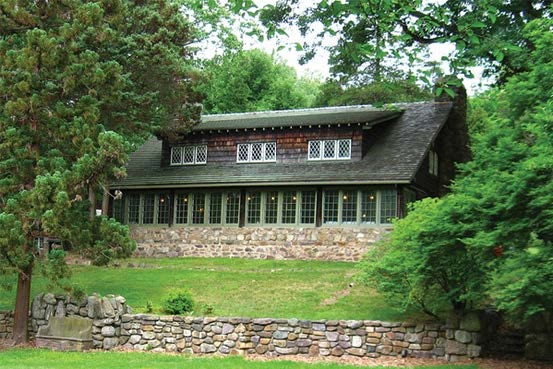
In September 2004 the restoration of Gustav Stickley’s Log House, a National Historic Landmark located at Craftsman Farms in New Jersey, was completed. The house was originally the private residence of Stickley from 1911 to 1917. The architectural style epitomizes the Arts and Crafts movement and was meant to be ‘harmonious with its natural setting.’ [1] The house is constructed primarily of exposed chestnut log walls, with Ludowici tiles on the roof and a fieldstone foundation.
The third phase of restoration began in 2001, when the deterioration of the logs became quite notice1able. To ensure the structural integrity of the logs, the preservation team needed to examine the building. Resistance drilling was chosen as the least destructive means of investigation; meaning a ⅛” to ¼” drill bit would be drilled into the logs while the resistance would be recorded. For this project, the IMLRESI (manufactured by IML GmbH of Germany) system, of resistance drilling was used to record the data to show ‘the internal voids and intermediate stages of decay.’
From the beginning the team wanted to ensure the preservation of the logs would retain the structural integrity of the house. An architect, material conservator and structural engineer investigated the house, looking for any material deterioration, significant movements, discolorations, growths, etc. Load distributions and performance were analyzed, which found the presence of overstressed elements. There proved to be deterioration of the logs on each of the exterior elevations, due to rot and termites. Because the house was primarily wood, the team feared the damage could be more extensive and expansive. They discovered further rot damage from the rafters to the porch’s ceiling joists to a post on the north corner of the west elevation.
They wanted to make sure they could locate and quantify the extent of the total deterioration. The team opted to perform a visual examination of the lower courses of the exterior logs, joists and all the exterior openings, while probing the logs to measure the moisture content. Since majority of the wood rot occurs from the center out, exterior damage is not as evident, but they hoped the probing during examination would allow for instant detection of any voids. The moisture content of the logs ranged from 8%19% but it was noted that this had been measured in the midst of a several month long drought, meaning the readings may not have been typical. Because so much damage had been discovered, the team realized these readings were not truly indicative of the extent of moisture and active decay. They opted to perform another round of resistance drilling on these lower courses of logs, color coding their findings based on the severity of the damage. Majority of the logs at the base, those adjacent to the window sills and the overhanging logs at the wall corners were all requiring repair. Wood epoxy was used to repair some of the concealed areas, but for the exterior repair, the the damaged logs needed to be carefully removed and replaced with salvaged chestnut logs.
The process of removing and replacing the logs was quite a challenge for the team, as the house’s remaining structure of the logs required further support, so the deteriorating logs could be cut and removed. The team worked together with a contractor’s engineer and were able to find a plan to replace all the logs at the base. During the remedying of the porch, it was discovered that half the ceiling joists had wood removed to host space for exterior lights; this had compromised the strength of the log beams causing them to become overstressed. They opted not to replace them, as the cutouts would still be necessary. Instead the team considered it better to reinforce the existing logs. They had the choice of using carbon-fiber composites or steel plate insertions, which they ended up using the latter. To do this, the second floor was shored, so that the logs could be temporarily removed. The logs were treated like a sleeve, so as to conceal the steel plates within, which were shaped to align with the ceiling contours. For the repair of the corner post, it was decided to introduce new stainless-steel elements as the damage of the wood post was so extensive. It was attached to both the new and original wood logs.
In my opinion, the use of resistance drilling made it possible to efficiently solve and remedy the deterioration of the logs. In the process of remedying the damaged wood, all effort was made to preserve as much of the existing logs as possible. The repairs which required replacements and the use of epoxy seemed necessary and it came across that the team had carefully debated these choices before implementation. However, I do not necessarily agree that a completely different material should have been introduced for the corner post. If the previous wood post was so far damaged, I believe they should have replaced it with a salvaged piece of log, just as the logs for the walls had been replaced. It seems that through the introduction of a stainless-steel post that some of the integrity of the house was changed.
[1]
Radcliffe Trenner, Anthony and Meade, “Wood Assessment and Repair of Gustav Stickley’s Log House at Craftsman Farms, New Jersey.” APT Bulletin 36, No.2/3 (2005): 2936
Discover more from Heritage Matters
Subscribe to get the latest posts sent to your email.
 Heritage Matters