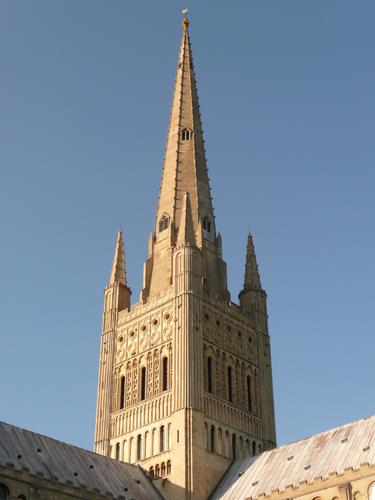
Norwich Cathedral, located in Norwich, Norfolk, England, was constructed between 1080 and 1120 in the Norman Romanesque style. It was built using flint and mortar, then it was covered in limestone. In 1463, the spire of the cathedral was hit by lightning, causing a fire and damaging the building. The Bishop at the time ordered a construction of a new spire, which was constructed of brick faced with stone, supported on brick squinches that were built into the tower. B.M. Feilden, the conservator architect for this restoration was commissioned to work on the Cathedral. Through visual analysis of the structure, he was able to establish: that the spire had cracked vertically on every side (8 sides in total), external stone was decayed and bulging and the internal brickwork was horribly decayed in several places. It was also discovered that a major crack had established between the stone and the brick core, likely caused by wind vibration.
Feilden’s approach for restoration was based on his belief that since the spire had managed to survive 500 years, post completion by John Everard in 1466, then there was no reason why it could not be restored to its original strength to withstand at least another 100 years. His proposal was to grout the voids existing between the stone casing and brick core, then introduce the insertion of ties across the brick’s vertical cracks with occasional ring beams. Due to the weak condition of the spire, Feilden opted not to add extra weight to the existing wind loading, therefore the scaffolding would need to be an independent element. He designed a “central octagonal ring with spring loaded ties to 8 external channels at the angles to restrain the spire at its weakest point.” [1]
It took 2 years through very harsh winters to complete the project. The first step taken was to fuse the interior junction of stone and brick through the use of grout. After that the ties were cut in and the masons hired to complete the brickwork began to cut out the defected bricks in 18-inch vertical strips. From the beginning, Feilden had warned the masons to only work at 3 places at once, which they ended up ignoring, causing severe damage to the already weak spire. It was discovered that the spire had moved while the masons were working on the brick, due to the fact that they opted to work at 9 different places at once instead of the recommended 3. Upon further investigation it was made apparent that there had been displacement along with the start of a crack around the circumference. The brick openings were immediately filled.
After completion of this restoration, a maintenance plan was formed and put into action. Every 5 years inspections would be carried out and every year the bays would be cleaned. After the cleaning, any damages discovered would be examined, with greater attention placed on the horizontal weatherings and pointing. Feilden claimed a proper maintenance program would be far more beneficial in the philosophy of repair versus restore. He also created a sliding scale of which to compare with visual analysis during maintenance checks; Immediate, Urgent, Necessary, Desirable, Monitor (with Immediate needing the quickest attention). Feilden believed using the same crew for maintenance every year would help diminish unnecessary problems from taking place.
[1]
Feilden,B.M., “From Restoration to Maintenance: A Case Study of Norwich Cathedral,” APT Bulletin Vol. 21, No. 3/4 (1989): 25.
Discover more from Heritage Matters
Subscribe to get the latest posts sent to your email.
 Heritage Matters