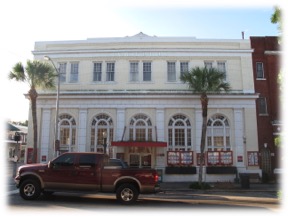
The two buildings that documented were the Shamrock Building and the Renaissance Building. Both of these buildings are important buildings in the downtown historic district of Mount Dora, as they were usefully implemented additions to the area. Since their original construction, they have been modified to provide better functionality for their new uses throughout the years. They both retain many fragments of their initial design and character, but mostly on the exterior; with regard to their interiors they have greatly altered.
The Shamrock Building (Fig. 1), currently a realtor’s office, was once the former Mount Dora Bank and Trust built in 1925; it was the first and only bank in Mount Dora. The main entrance was formerly on the east façade of the building, but after its change to the Shamrock Building, the entrance was moved to the north façade of the building while the east entrance was filled in and made to match the surrounding wall. As a bank, the ground floor was filled with a series of teller windows, metal cages, a large vault and marbled countertops, floors and wainscoting throughout. The second floor had a secondary vault and a mezzanine floor and office spaces on the third floor, all of which featured wood paneled walls.
After it’s transition to a realtor’s office, just about every bank related element on the ground floor was removed except portions of the marble flooring and wainscoting (Fig. 2). All of the original light fixtures were removed and partitions and cubicles were introduced. The mezzanine and third floor offices were minimally changed. However, in 2008, a tropical storm wrecked havoc on the building, causing serious damage to the interiors. The water damage was so pervasive it damaged the wood paneling on the third floor and second floor mezzanine, and leaked completely through the building to the ground floor. Water damage is still visible on the interior walls of the ground floor. The wood paneled walls of the third floor offices are still in disrepair and a musty smell still permeates the mezzanine and third floor. Despite the damage and the alterations over the years, sections that remain of the original marbled floors and wainscoting are in very good condition.
A similar example is that of the Renaissance Building, which is currently a mixed-use commercial building filled with retail shops, restaurants, bars and office space. It was originally a hotel built in the 1920s, referred to as the Dora Hotel. The hotel functioned until the mid- to late-1970s and once the 1980s hit the building became vacant. It transferred several owners before it was retrofitted to serve as a mixed-use commercial building.
The interior aspects of the building have completely changed as the layout was altered to fit separate retail stores and offices, merge spaces for restaurants and completely open up the building to the public as a walk-through shopping mall of sorts. The only historicity this building can claim is its slightly altered exterior; as for the interior, compromises have been made, but unfortunately not in favor of the protection and preservation of historic features. In this case, the Shamrock Building, and many buildings found in the historic downtown, the exteriors retain much of their historic integrity, but the interiors have changed too much and lack much of any connection to their former use.
Discover more from Heritage Matters
Subscribe to get the latest posts sent to your email.
 Heritage Matters