Summary Paragraph
The Mount Dora Bank & Trust Co. is an early 20th century bank building situated on the southeast corner to the entrance of the historic downtown and commercial district of Mount Dora, Florida. The building is located on the main corner of Donnelly Street (east façade) and Fifth Avenue (which is the main entrance on the north façade). It is a 3 story, Masonry Vernacular style building with an irregular rectangular plan. The exterior walls are constructed of running brick which has been painted a creamy yellow color and the foundation is built of concrete and concrete block, which has been finished with beaded mortared joints. There are white decorative, paneled pilasters with an entablature and cornice flanking both the east and north of the building. The building is in good condition and other than the change of color and relocation of the main entrance, has retained the majority of its exterior integrity.
Narrative Description
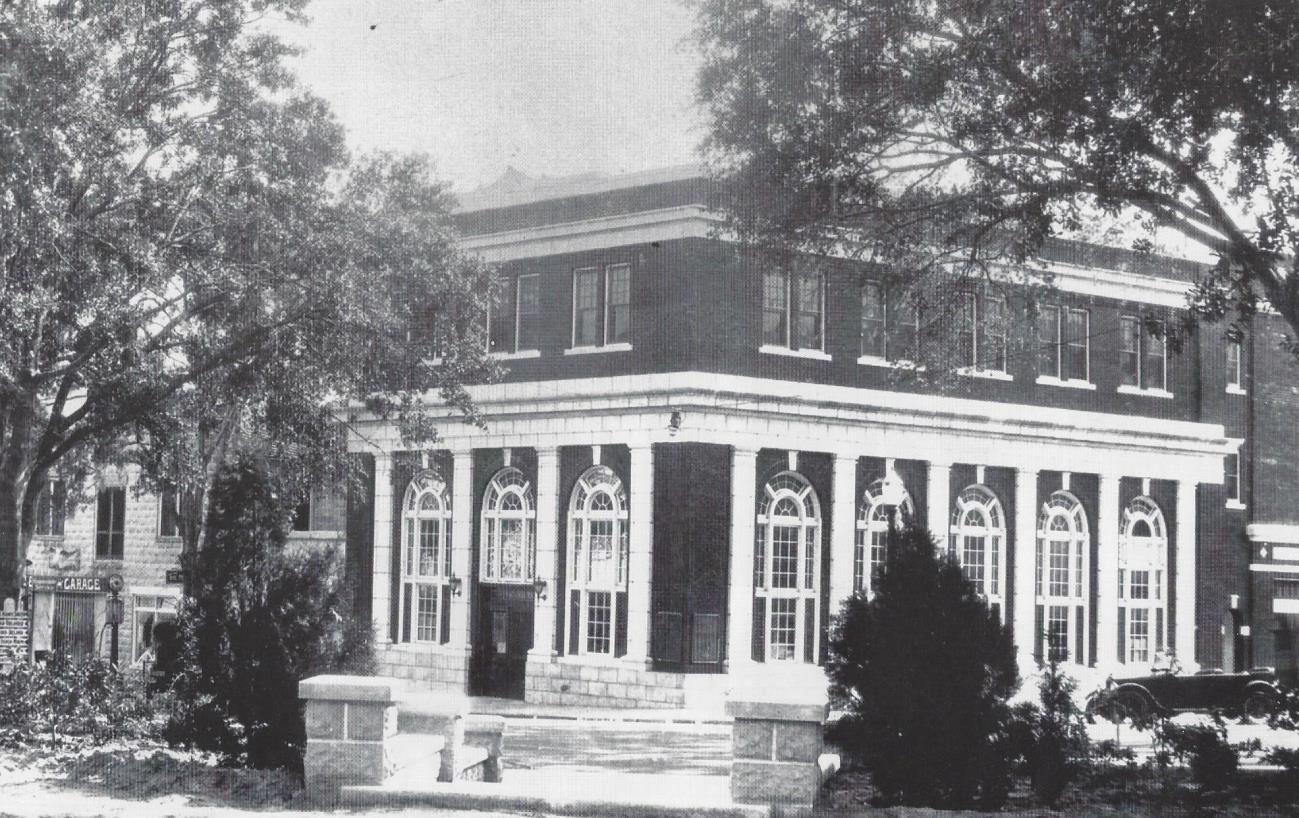
The former Mount Dora Bank & Trust Co. is located on the main thoroughfare corner of Donnelly Street and Fifth Avenue. The building was constructed in a Masonry Vernacular style with a continuous, concrete block foundation. The exterior walls were constructed of hollow clay tile and running brick in their original reddish fired color. The plan was that of an irregular rectangle with the main entrance facing east to Donnelly Street. On the eastern exterior entrance were three bays filled with wooden Palladian double height windows, the center bay hosted the main entrance glass, double doors, while the north façade, facing Fifth Avenue, had five bays filled with the same wooden Palladian double height windows. Between the bays were white decorative, concrete paneled pilasters with an entablature and cornice flanking both the east and north facades of the building. On the third story there were two wooden double-hung windows atop each of the double height Palladian windows, accounting to six on the east façade and ten on the north façade. A secondary cornice was located just above the third story windows on both the east and north façades. The roof was flat with a simple incline to extract water from the rainfall and it had a built up pediment.
Plaques bearing the bank’s name were predominantly displayed on both sides of the building on the corner of the thoroughfare of Donnelly Street and Fifth Avenue. The main entrance, glass double door was lined with two exterior sconce lights, one on either side. Within the interior of the building was a marble tiled flooring and marble wainscoting. The ground floor was a double height space of about 22 feet. Teller windows on the ground floor, spanned from the east to west ends of the building. They had marble countertops with brass and bronze cages which separated the tellers from the public. To the rear of the main floor lobby, which was the west end of the main floor, there was a state of the art safe with a circular door. The safe was from the New York Safe and Lock Co. and housed about 300 safety deposit boxes and featured hexagonal tiled flooring.
The double height space of the open plan of the ground floor was further enhanced by the decorative ceiling which spanned the entire building. The ceiling featured a coffered design with elaborate crown molding. A staircase in the rear led to a partial second floor mezzanine which extended from the south wall out about 20 feet. It contained an equipment room and a smaller safe. A third floor was also added; this was where the bank’s officers had their offices and a meeting space within a boardroom. The walls of these rooms were wood-paneled in mahogany. The light fixtures were of an elaborate nature and were incorporated for every light. There were three bathrooms in the entire building, with one located on each floor. The two on the ground and second floors were half-bathrooms, while the one on the third floor was a full executive bathroom featuring a shower.[1]
The bank witnessed the further development of the town of Mount Dora, without much change or affect to the institution or the building. First National Bank of Mount Dora ultimately moved locations, moving further north on Donnelly to 714 North Donnelly Street around 1965.[2] Around the same time E. E. Husky, a local realtor, purchased the building from Simpson. It was transformed it into a realty office and Husky simultaneously made a few alterations. The exterior brick walls were painted green and awnings were added to the third story windows on both the east and north façades. The main entrance was moved from the east façade to the north façade, facing Fifth Avenue. The doorway of the east façade was replaced with a wooden Palladian double height windows, made to match the existing, surrounding windows and the new glass double doorway was situated on the north façade, in the third, middle bay. The safe on the ground floor was removed from the building. The main open plan of the ground floor changed as the tellers and marble countertops were removed, retaining the original marble flooring and wainscoting. The second floor mezzanine and third floor executive offices were used and maintained, including the secondary safe on the second. All of the decorative light fixtures were removed.
In 1991 the building would again change ownership. Keith Shamrock, another local realtor, bought the building from Husky to house his realty office. Once more the building would see minor alterations. All of the exterior awnings were removed, with the exception of the one hovering over the main entrance. The brick walls were painted a creamy yellow color. The name of the building changed to that of the Shamrock Building and the new name was added to both the east and north façades of the building on the brick banding, just below the dentil. Partitions and cubicles were added to the ground floor, in an effort to create segmented office spaces within the open plan. The building has since been rented to the Real Living Good Neighbor Realty, although the building remains owned by Shamrock.
Hurricanes and tropical storms through the years have caused significant damage to the building, especially the 2008 Tropical Storm Fay, which completely destroyed the third floor and second floor mezzanine. Water damage was substantial, damaging the wood paneling and carpeting of the offices located on the third floor. The influx of excess water leaked to the second floor mezzanine and the ground floor causing further damage. To date, the damage is still visible. From the ground floor, patches and water damage on the walls are noticeable. The third floor’s wood paneled walls are still in disrepair and a musty smell continues to permeate the second and third floors.[3]
Despite this damage, the building is in good condition and other than the change of color and relocation of the main entrance, it has retained the majority of its exterior integrity with regards to its location, design, setting, materiality, feeling and association. Although the interior has been altered with the removal of the key bank elements of the tellers, marble countertops and the safe, the marble tiled flooring and wainscoting remain and are in very good condition, regardless of the extensive water damage. Granting it has been the Shamrock building since 1991, this building’s grand design continues to be a reminder of the past and the early days of Mount Dora.
Statement of Significance Summary Paragraph
The Mount Dora Bank & Trust Co., built in 1925, was one of many buildings in town built, owned and operated by James W. Simpson. Simpson was a very influential community member who founded the majority of what makes up the infrastructure of present day Mount Dora. His father, David Simpson, and grandfather, M.V. Simpson, were the first settlers of Mount Dora in 1874.[4] David Simpson was the first to set root in Mount Dora, homesteading 160 acres facing Lake Dora, which is the current historic downtown of Mount Dora. His grandfather, M.V. Simpson, homesteaded another 160 acres in a tract adjoining his son.[5] When James came of age he followed in these footsteps, continuing to make positive, impactful changes to benefit Mount Dora. Through the Mount Dora Bank & Trust Co., he founded the first financial institute of Mount Dora and the surrounding area, which would be housed in this building once construction was completed in 1926. The building meets National Register Criterion A, in the significance of an Event as it was the first bank in the area, and Criterion B, as the builder and owner of the building was a significant, leading founder of the community’s infrastructure.
Narrative Statement of Significance
The property, which was located on the main thoroughfare corner of Donnelly Street and Fifth Avenue, was bought by James M. Simpson from the Whitney family in 1925. The previous structure owned by the Whitney family had been destroyed due to a devastating fire in 1922, which also destroyed quite a majority of the downtown area of Mount Dora. The original bank, Bank of Mount Dora, of which Simpson was the founder and president, was located at 404 Donnelly Avenue (Mount Dora), just 4 buildings south on the opposite side of the street.
Simpson had been responsible for much of the infrastructural development within Mount Dora. He was a descendent of the first settlers of Mount Dora, through his father, David Simpson, and grandfather, M.V. Simpson, who homesteaded in the current historic district of Mount Dora in 1874.[6] Between his father and grandfather they owned 320 acres of land, most of which was orange groves. James Simpson followed in their footsteps and was a very successful citrus farmer. He was also a very influential community member and took great strides to develop Mount Dora.
He organized the Mount Dora Citrus Growers Co-Op and managed the group until 1933. He owned a local grove maintenance business, servicing the local farmers and groves. He built a Citrus Packing Plant, which would later become a successful Ice House and later a World War II Youth Center. He founded Mount Dora’s first dairy in 1918. He was responsible for the fundraising efforts and realization of the first school in Mount Dora, Educational Hall. Simpson was also behind the petitioning for the founding of Christian Home and Bible School. Also most importantly, he was responsible for the paving of Mount Dora’s first roads.[7]
His family was responsible for significant development within Mount Dora around the same time that Simpson was buying the property at the corner of Fifth Avenue and Donnelly Street. His father had just built the Princess Theatre in 1923, also on Fifth Avenue, just 2 buildings west of the property. While at the same time, his brother, Howard Simpson, was constructing the Simpson Building (eventually the Simpson Hotel), on Fifth Avenue, adjacent to the property.[8]
Simpson’s motivation for purchasing the property was to construct a larger bank, as the current bank’s space was not large enough to accommodate the growing financial needs of the town; for this endeavor he commissioned the architect Gamble Rodgers of Winter Park, Florida; the same architect his brother Howard Simpson had commissioned to build the Simpson Building. At this time and in this area, the commissioning of an architect was an expensive feat and very few were consulted or sought out. Construction began in July 1925 and was not completed until March 1926.[9] While waiting for the construction to finalize and still at the previous location, the bank established its charter and on September 12, 1925, re-opened its doors to the public as the state bank of Mount Dora Bank & Trust Co.[10]
On July 6, 1927, the bank received the charter to become a national bank, again changing its name to the First National Bank of Mount Dora. George White, Sr., from the Federal Reserve Bank in Jacksonville, Florida, relocated to Mount Dora to serve as vice-president, eventually becoming president and CEO after Simpson’s inevitable resignation. The bank survived the Great Depression, maintaining financial stability within Mount Dora and the surrounding area.
The bank witnessed the further development of the town of Mount Dora, without much change or affect to the institution or the building. First National Bank of Mount Dora ultimately moved locations, moving further north on Donnelly to 714 North Donnelly Street around 1965.[11] Around the same time E. E. Husky, a local realtor, purchased the building from Simpson. It was transformed it into a realty office and Husky simultaneously made a few alterations.
In 1991 the building would again change ownership. Keith Shamrock, another local realtor, bought the building from Husky to house his realty office. Once more the building would see minor alterations. The building has since been rented to the Real Living Good Neighbor Realty, although the building remains owned by Shamrock.
Discover more from Heritage Matters
Subscribe to get the latest posts sent to your email.
 Heritage Matters